

Table of Content
Gaming is evolving beyond pure entertainment, now offering real-world economic opportunities through player-driven ecosystems.
Unlike traditional games where players invest money without any financial return, Play to Earn games reward players for their in-game achievements with assets that hold real value, such as cryptocurrencies and non-fungible tokens (NFTs).
The Play to Earn gaming sector is ideal for entrepreneurs looking to make a fruitful investment. Recent estimates indicate that the global blockchain gaming market could exceed $314 billion by 2030, and the growth potential is incredible.
If you are also looking forward to marking your journey into the Play to Earn game development, then this blog is for you. This guides you through the ins and outs of play to earn game development, highlighting the key trends and other useful insights to help you make informed business decisions in the evolving market.
Without further delay let us get started!
Essential Steps to Develop A Play to Earn Gaming Platform
Developing a Play to Earn game requires proper planning and a strategic approach along with advanced technology to develop an outstanding Play to Earn game.
Here is a simple breakdown of the steps involved in developing a play-to-earn game.
Step 1: Defining Objectives
Establishing clear objectives is crucial for the development of play-to-earn games. This involves identifying the target audience, understanding their likes and dislikes, and outlining the unique selling propositions (USPs) that will differentiate the game in a competitive market.
Step 2: Prototyping And Designing
Creating a prototype is important to analyze the gameplay mechanics and earning systems before full-scale production.
This initial version focuses on essential features to gauge player interest and gather feedback.
Emphasizing engaging design is equally important as it ensures that players find the game to be enjoyable and easy to navigate.
Step 3: Blockchain Implementation
Integrating blockchain technology is essential for enabling secure transactions and true ownership of in-game assets.
You must choose the right blockchain platform for P2E game development and implement smart contracts to automate processes like rewards and bonuses.
Step 4: Asset Creation And Tokenization
This phase involves the creation of digital assets, such as characters, items, or virtual land, which can be tokenized as NFTs.
Make sure that these assets are visually appealing and functional within the game to enhance player engagement.
Pro tip: Establishing a marketplace for trading these tokens will provide players with opportunities to buy, sell, or exchange their assets seamlessly.
Step 5: Development
The actual development of the game takes place in this step which involves coding and building the game using suitable engines like Unity Engine.
Here the utmost focus will be on creating smooth gameplay experiences with intuitive controls and responsive interfaces.
Step 6: Testing And Deployment
Thorough testing is conducted to ensure that all game features function correctly before reaching the end users.
Once testing is completed, the game can be deployed on various platforms, making it accessible to players.
Step 7: Post-launch Maintenance
After launching the game, ongoing maintenance is necessary to address bugs, implement updates, and introduce new content based on player feedback.
Note: Regularly engaging with the community through updates or events helps retain player interest and encourages continuous investment in the game's ecosystem.
Looking for a Play-to-Earn Game With Powerful Web3 Features?
Fourchain creates immersive P2E gaming platforms powered by
- true digital ownership
- blockchain transparency
- cross-platform interoperability.
Collaborate with Fourchain to build your P2E game



Key Features Of A Successful Play to Earn Game
Here is a checklist of certain key features to consider while developing a play-to-earn game, to create compelling experiences that attract players while offering them an opportunity for financial gain.
Take a look at it.
Decentralization
Decentralization is a fundamental aspect of P2E games, which allows players to have control over in-game assets and economies rather than being governed by a third party.
This empowers players to trade, sell, or utilize their assets freely, fostering a sense of ownership and community involvement.
True Asset Ownership
In P2E games, players truly own the digital assets they earn, such as NFTs and cryptocurrencies.
Unlike traditional games where items are limited to the game environment, these assets can be traded or sold on external marketplaces for real-world value.
This feature not only enhances player investment in the game but also allows players to earn profit from their efforts.
Monetization Opportunities
Effective monetization strategies are essential for P2E games, which allow players to earn cryptocurrency or NFTs through various in-game activities like winning battles.
This creates a direct link between gameplay and financial rewards, fostering players to play more.
Transparency
Blockchain technology ensures that all transactions within P2E games are transparent and tamper-proof.
Players can verify the authenticity of transactions and ownership of assets, which builds trust in the game's economy. Transparency helps prevent fraud and enhances player confidence in the game.
Interoperability
Interoperability allows assets from one P2E game to be used in other games within the same ecosystem.
This feature enhances the value of in-game items and encourages players to explore multiple games, as their investments can carry over across various platforms.
Engaging Gameplay Mechanics
To attract and retain players, P2E games must offer engaging gameplay mechanics that keep users entertained while they earn rewards. Incorporating elements like quests, tournaments, and other battles can enhance the gaming experience.
A well-designed game that balances fun with earning potential will encourage longer play sessions and higher player satisfaction.
Community Engagement
Building a strong community around P2E games is essential for long-term success. You should include features like leaderboards, forums, and guilds where players can share strategies and experiences.
Engaging with the community not only enhances player loyalty but also acts as a platform to gain valuable feedback for ongoing game development.
Types Of Play To Earn Games
After exploring the development process and key features of play-to-earn games, it's essential to understand the various types available in the market.
This knowledge will help you gain insights into what kind of game you might want to create. Here are some of the primary categories of play-to-earn games.
Strategy Games
Strategy games require players to engage in resource management and tactical decision-making to build empires or defeat opponents.
Players can earn crypto by successfully executing strategies and winning. Alien Worlds is the best example of strategy games.
NFT Games
NFT games focus on unique digital assets represented as non-fungible tokens, which players can own, trade, and utilize within the game.
These games often include various mechanics for earning rewards through gameplay. Famous examples are Axie Infinity and Illuvium.
Role-Playing Games
Role-playing games allow players to create and develop characters while completing quests and engaging in battles.
Players earn cryptocurrency by completing missions, defeating enemies, or trading valuable in-game items. Well-known examples include Big Time and Crypto Raiders.
Collectible Card Games
Collectible card games allow players to collect, trade, and battle with digital cards that represent unique characters or abilities.
Players can earn cryptocurrency by winning matches or selling rare cards on marketplaces. Popular examples include Splinterlands and Gods Unchained.
Virtual Real Estate Games
In virtual real estate games, players can buy, sell, and develop virtual properties within a digital world.
Players earn cryptocurrency through transactions or by creating valuable experiences on their land. Popular platforms like Decentraland and The Sandbox are examples.
Play to Earn Games Revenue Streams & Monetization Strategies
Play to earn games generate income through various innovative revenue streams. Here are key ways these games make money with real-world examples.
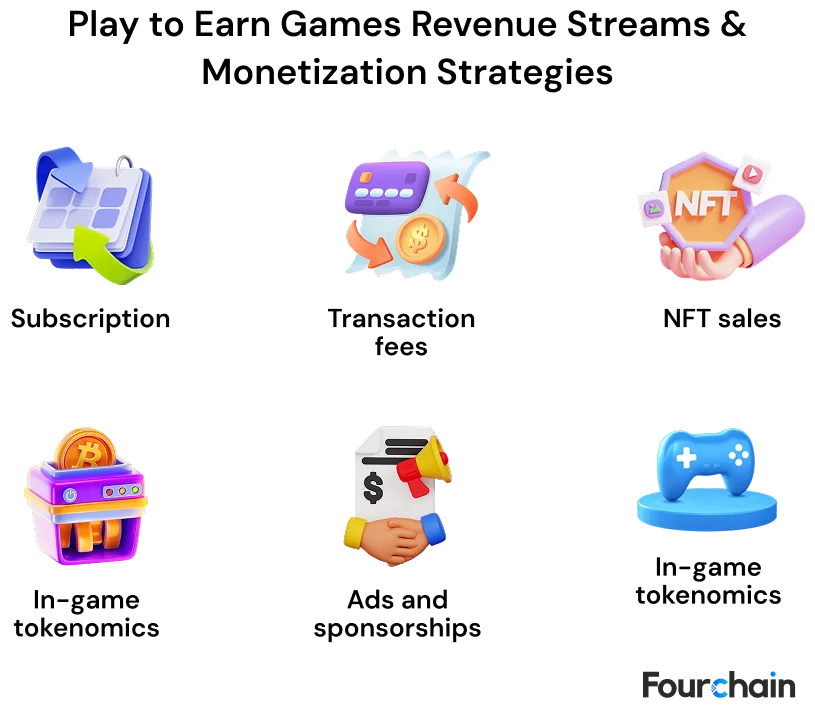
Subscriptions
Subscription models allow players to access games for a recurring fee, providing admins with a steady revenue stream.
This model can include premium memberships that grant exclusive in-game content or benefits, enhancing player engagement.
For instance, platforms like Xbox Game Pass offer access to a library of games for a monthly fee.
Games like Illuvium and Guild of Guardians offer premium memberships with exclusive in-game benefits, ensuring a steady income stream.
NFT Sales And Marketplace Transactions
NFT sales involve the creation and trading of unique digital assets within the game, allowing players to buy, sell, or trade items for real-world value.
Admins earn revenue through transaction fees on these marketplace exchanges, creating a continuous income stream as players engage in trading activities.
For example, games like Axie Infinity and The Sandbox generate revenue from NFT transactions within their built-in marketplaces.
In-Game Tokenomics
In-game tokenomics refers to the economic systems established within the game that utilize cryptocurrencies or tokens for transactions and rewards.
Admins can generate revenue by selling these tokens directly to players or by charging transaction fees for token exchanges within the game's ecosystem.
This model incentivizes player participation while creating a vibrant in-game economy.
Decentraland uses its native MANA token, allowing players to purchase virtual land and items within the game.
Ads And Sponsorships
Integrating advertisements and sponsorships into P2E games can provide additional revenue streams without directly charging players.
Admins can partner with brands to display ads or sponsor in-game events, generating income based on player engagement with these promotions.
Gods Unchained has partnered with blockchain companies for ad placements and sponsored events.
Entry Fee For The Game
Charging an entry fee for participating in certain game modes or tournaments can be an effective way to generate revenue while ensuring that players are invested in their experience.
This model often applies to competitive games where players pay to compete for prizes and potential rewards.
For example, some P2E games may require players to purchase an initial asset or token to start playing.
And a famous game like Splinterlands regularly hosts tournaments where players pay entry fees to compete for prize pools, adding an esports appeal to the game.
Final Thoughts
Play to Earn game development is a tedious process, but understanding the mechanisms can help entrepreneurs easily sail through this and secure their position in this dynamic market.
If you are looking to develop your own Play to Earn game, Fourchain is a leading blockchain game development company that can help you bring your ideas to life. With expertise in game design, blockchain integration, and monetization strategies, our team can guide you through every step of the blockchain based game development process.
Let us partner with you to create a successful play-to-earn game and make it a big hit.
Get in touch with Fourchain to discuss your P2E game development project.

