

Table of Content
Liquidity management is one of the most important success factors of any cryptocurrency exchange. Simply put, liquidity determines how easily traders can buy or sell crypto assets without facing price spikes, delays, or heavy losses due to slippage. Without sufficient liquidity even the most advanced trading platform can struggle to retain users.
Imagine a trader placing an order but no one is available on the other side. Or worse, the price changes sharply before the trade is completed. These situations are common on low-liquidity exchanges and often push users toward competitors with deeper order books and smoother trade execution. This is why liquidity is not just a technical metric; it directly impacts user trust, trading volume, and the long-term growth of a crypto exchange.
In this blog, we’ll explain liquidity management in crypto exchanges in simple terms and show you why it matters for both exchange owners and traders. You’ll learn proven strategies to increase liquidity, reduce volatility, and create a stable trading environment that attracts and retains active users.
Whether you’re launching a new exchange or optimizing an existing one, this guide will help you build a more liquid, competitive, and profitable crypto trading platform.
Crypto Exchange Liquidity Management Strategies
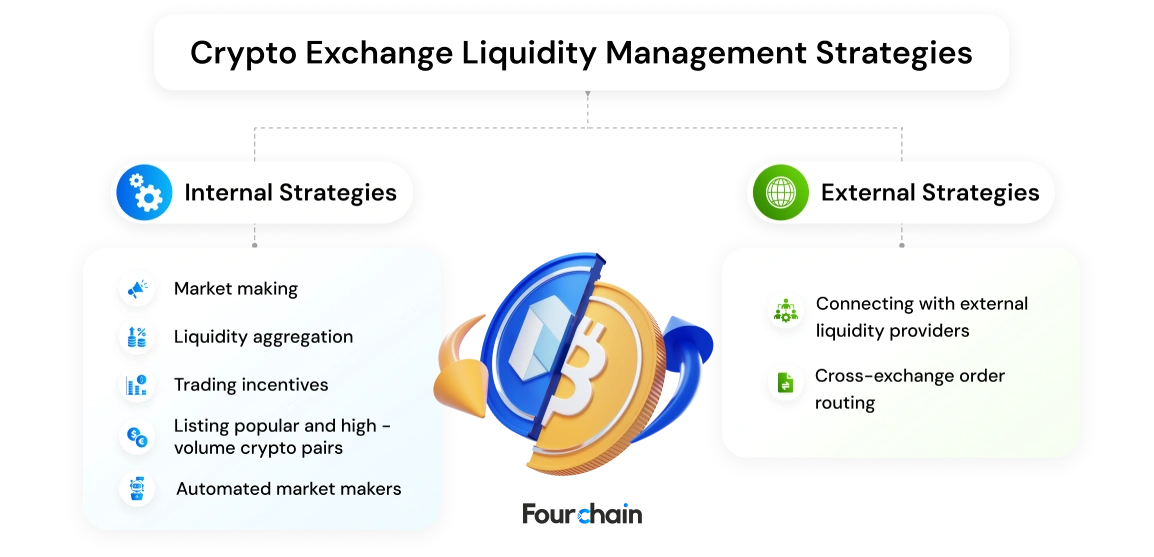
Internal Strategies
1. Market Making
Market makers continuously place buy and sell orders, ensuring smooth trade execution and reducing price volatility. They are incentivized through competitive compensation models and technical support to maintain consistent liquidity.
2. Liquidity Aggregation
Liquidity aggregation involves pooling liquidity from multiple internal sources to improve order book depth and reduce slippage. This strategy helps exchanges offer competitive pricing and faster trade execution.
3. Implementing Trading Incentives
Trading incentives, such as fee discounts and rebates, encourage traders to engage more actively, thereby boosting liquidity. These incentives can be tailored for high-volume traders and market makers.
4. Listing Popular & High-Volume Crypto Pairs
Listing widely traded cryptocurrencies attracts more users and increases trading activity, naturally enhancing liquidity. Popular pairs like BTC/USDT and ETH/USDT are particularly effective.
5. Integrating Automated Market Makers (AMMs)
AMMs use smart contracts to provide liquidity without traditional order books, allowing for decentralized and automated trading. They are commonly used in decentralized exchanges (DEXs) to enhance liquidity.
External Strategies
1. Connecting with External Liquidity Providers
Partnering with external liquidity providers allows exchanges to access deeper order books and improve price discovery. This strategy helps smaller exchanges compete with larger platforms.
2. Cross-Exchange Order Routing
Cross-exchange order routing directs trades to the best available prices across multiple platforms, reducing slippage and improving trading efficiency. This strategy enhances liquidity by leveraging the strengths of different exchanges.
Effective & Proven Liquidity Management Techniques
Continuous Monitoring of Order Books
Continuous monitoring of order books allows exchanges to track liquidity metrics in real time, enabling swift responses to changes in market conditions. This involves analyzing bid-ask spreads, order book depth, and trading volumes to ensure optimal liquidity. By doing so, exchanges can maintain stable and efficient trading environments.
Balancing Token Pairs
Balancing token pairs involves ensuring that liquidity is evenly distributed across all trading pairs, not just high-volume ones. This prevents less popular pairs from becoming illiquid and ensures a consistent trading experience across the platform. Exchanges can incentivize liquidity providers to support less popular pairs.
Managing Liquidity during High-Volatility Periods
Managing liquidity during high-volatility periods requires proactive strategies like deploying liquidity pools or activating circuit breakers to stabilize markets. These measures help prevent price spikes and ensure that trading remains stable even during rough times. Effective risk management tools are crucial for maintaining liquidity during such periods.
Ensuring Regulatory Compliance
Ensuring regulatory compliance is essential for maintaining trust and stability in crypto exchanges. Compliance with local and international regulations helps attract institutional investors and enhances the exchange's reputation. It also mitigates the risk of legal issues that could disrupt liquidity.
Maintaining Robust Technological Infrastructure
Maintaining robust technological infrastructure is vital for supporting high liquidity levels. This includes using efficient order-matching algorithms, scalable systems, and secure networks to handle large trading volumes without downtime. A reliable infrastructure ensures fast trade execution and minimizes technical risks that could impact liquidity.
Want to boost liquidity on your crypto exchange?
Fourchain helps you integrate reliable liquidity solutions that keep your exchange active, competitive, and ready for high-volume trading.



Challenges In Managing Liquidity In A Crypto Exchange
Low Trading Activity In Early-Stage Platforms
Early-stage crypto exchanges often struggle with low trading activity due to limited user bases and fewer trading pairs, which hampers liquidity. This creates a vicious cycle where low liquidity discourages traders, further reducing trading activity.
High Volatility In Crypto Assets
Cryptocurrencies are known for their high price volatility, which can deter traders and reduce liquidity by making markets unpredictable and risky. Volatility can lead to sudden price swings, causing traders to hesitate in engaging with less liquid markets.
Regulatory Hurdles and Market Limitations
Regulatory uncertainty and varying legal frameworks across regions can create barriers to liquidity by affecting investor confidence and limiting market participation. Clear regulations are essential to foster trust and encourage trading activity.
Trust Deficit Among Traders and Investors
New exchanges often face a trust deficit among traders due to concerns about security, reliability, and reputation. Building trust is crucial to attract users and increase liquidity, as traders are more likely to engage with platforms they trust.
Reasons Why Liquidity is Important in a Cryptocurrency Exchange
Understanding why liquidity is important to run a successful cryptocurrency exchange is essential for both traders and platform operators. High liquidity facilitates quick transactions, enhances pricing accuracy, and stabilizes the market, creating a better trading environment.
By prioritizing liquidity, exchanges can attract more users and foster trust within the cryptocurrency community. Let’s quickly explore more about them.
1. Facilitates Quick Transactions
High liquidity indicates that there are adequate buyers and sellers in the market, ensuring trades are completed within a relatively short period with little delay. This is more crucial in the volatile cryptocurrency market where prices can fluctuate rapidly.
Importance
Instant Execution
The ability to execute one's orders within an almost immediate period is more essential in a liquid market. It is important when the volatility is high because the price can shift within seconds.
This leads to reduced wait times, hence lower chances of delayed execution of trades, an aspect critical for maintaining user satisfaction and engagement.
Example Use Case
A trader with $100,000 in Bitcoin could easily sell his/her asset on an exchange like Binance that has high liquidity, which means his order would fill instantly without the trader having to wait for other market participants.
Conversely, such an order could take some time to fill in an illiquid exchange, with losses due to changes in prices when there is a sudden market fall, for example. The seller would have sold his Bitcoin when its price was lower compared to its market price had his order executed faster.
2. Better Pricing and Tighter Spreads
Liquidity further helps traders have better pricing. When many people are active participants in the market, this is bound to give tight bid-ask spreads. It means that the difference between the selling price and buying price is as narrow as possible.
Importance:
Cost Efficiency
Lower spreads mean that when traders buy, they pay less and get more on sale. This makes the cost efficiency attractive to the high-frequency trader, who trades based on very small price movements.
Fair Market Value
Liquidity at its peak ensures that the prices reflect true market value for assets. With high liquidity, a trader will have confidence that they are being offered a fair price based on supply and demand at the moment.
Example Use Case
A trader on Coinbase Pro is able to benefit from very tight spreads, meaning they are able to purchase Ethereum at a price very close to the market value. On a less liquid exchange, they would pay wider spreads and thus be able to get higher costs.
For instance, if Ethereum is priced at $2,000 and $2,050 on a very illiquid exchange, then the wider spread would cost the traders much more than it would have cost if they traded on a liquid platform where the spread could be $10.
3. Market Stability
A liquid market is less vulnerable to sharp price movements due to massive trades. With many buyers and sellers, huge orders can be absorbed without having a major impact on prices.
Importance
Low Volatility
Liquidity at high levels ensures stable prices, and hence, the trader can better predict the market movements. Stability is crucial for long-term investors, who are otherwise scared off by wild fluctuations in asset values.
Confidence in Trading
Traders are more likely to engage in buying and selling when they know that their actions won’t significantly affect market prices. This confidence encourages more trading activity overall.
Example
During major market events such as Bitcoin halving or regulatory announcements, exchanges with strong liquidity can sustain large volumes of trades without showing extreme price variations.
When Tesla announced its investment in Bitcoin, exchanges with robust liquidity could take the inflow of buy orders without triggering any significant price jumps or falls.
4. Improved User Experience
High liquidity improves the experience directly because users are always able to get in and out of a position without complication or unexpected costs, leading to better user satisfaction and retention.
Importance
User Retention
A happy trader will always come back to use the system again. This positive trading experience makes them willing to promote the exchange to friends.
Attract new users
High liquidity reputation can attract new traders to seek reliable trading environments where they can execute their strategies effectively.
Example Use Case
Kraken's good liquidity reputation attracts more and more retail and institutional traders who need a smooth trading experience. There is a lesser chance to encounter a slippage or even failed order if a great quantity of liquidity is present on the platform.
For instance, a trader wants to sell a large amount of Litecoin quickly, yet encounters slippage due to low liquidity on another platform. The trader will have all reasons to prefer Kraken for reliable execution.
5. Attracts Institutional Investors
Institutional investors look for exchanges with high liquidity because they are sure that they are going to be able to execute large trades without affecting the market prices much.
Importance
Higher Trading Volume
Attracting institutional investors maximizes volumes. Their entry brings large amounts of capital into the market and benefits all users.
Legitimacy and Trust
High liquidity will signify stability and reliability in institutions. These institutions will always engage with more exchanges that prove to have higher trading activity.
Example Use Case
Institutions have been attracted to exchanges such as Bitfinex, which maintains deep liquidity in most trading pairs. This gave it an increased trading volume and credibility in the crypto space. Even large trades, for example those after high-profile announcements from the likes of MicroStrategy, that would traditionally knock the price had little chance of doing so at Bitfinex.
6. Enables price discovery
Liquidity is critical in the price discovery process the way markets determine the value of assets based on supply and demand dynamics. High liquidity allows for more accurate pricing as trades reflect real-time market conditions.
Importance
Accurate Valuations
Well-informed pricing helps traders make better investment decisions based on current market trends rather than outdated information.
Market Efficiency
Efficient markets allow assets to be traded at their fair value based on current information available from all participants.
Example
On exchanges like Huobi, where liquidity is robust, traders can see real-time price movements that accurately reflect supply and demand dynamics. This transparency fosters trust among users regarding asset valuations; if users notice discrepancies between different exchanges due to low liquidity elsewhere, they may choose Huobi for its reliability in pricing.
7. Mitigates Market Manipulation
High liquidity makes market manipulation hard, as no one trader or team of traders can inflate asset prices sufficiently. In liquid markets, any large trade makes the price shock very high to be exploited by malicious traders.
Importance
Fair Trade Environment
This is a favorable environment where all players are offered equal opportunities by ensuring that prices cannot be driven up easily by an individual player who can make enormous trades.
Increased Trading Confidence Among Traders
With less likelihood of market manipulation, more traders want to trade more.
Example
Exchanges like Bittrex monitor trade activity and employ algorithms that will try to identify these patterns indicative of manipulation. High liquidity will help in dissipation of trades across a multitude of participants so much that in such a highly liquid market, no trader or group of traders can manipulate the prices unduly.
Final Thoughts
Liquidity is the backbone of any successful cryptocurrency exchange, ensuring smooth transactions, stable prices, and efficient trading experiences.
By understanding the intricacies of liquidity and implementing effective strategies like market-making and leveraging technology, exchanges can enhance their trading environments.
With the help of an enterprise grade cryptocurrency exchange development company like fourchain, liquidity challenges can be addressed with proper infrastructure.
Whether you're looking to launch a new exchange or optimize an existing one, our team is dedicated to helping you achieve your liquidity goals and drive growth in the competitive crypto landscape.
Contact us today to explore how we can help you build a secure and thriving cryptocurrency exchange.

