

Table of Content
Triangular arbitrage bot is an automated system that exploits price differences between three cryptocurrency pairs on the same exchange by executing trades.
By running 24/7, a triangular arbitrage bot effectively reduces manual effort and speeds up the execution process. Thus, playing a vital role in making profits in highly competitive markets!
How Triangular Arbitrage Bot Execute Trades?
- First, it scans the market and tracks the trading pairs across various exchanges.
- Then, it spots mispricing and looks for cycles where converting through those three cryptocurrencies would create profit.
- So, once it finds out, it instantly places buy and sell orders to complete the loop!
For instance,
Let's say the bot is checking a cycle like BTC-ETH-USDT-BTC.
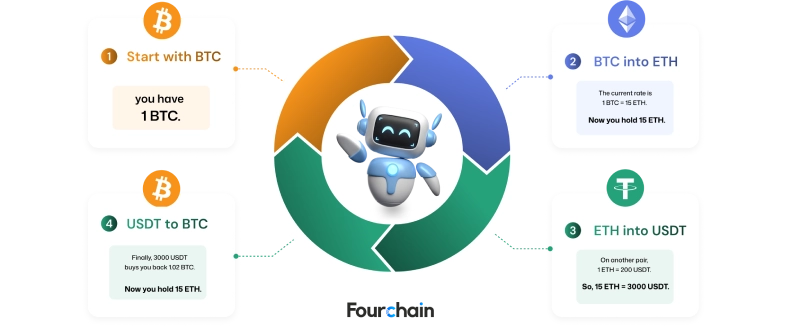
Step 1: Start with BTC, you have 1 BTC.
Step 2: BTC into ETH
The current rate is 1 BTC = 15 ETH. Now you hold 15 ETH.
Step 3: ETH into USDT
On another pair, 1 ETH = 200 USDT. So, 15 ETH = 3000 USDT.
Step 4: USDT into BTC again
Finally, 3000 USDT buys you back 1.02 BTC.
You started with 1 BTC and ended with 1.02 BTC, thus making a profit of 2% in a single cycle!
So, what is going on behind the scenes?
The bot does more than just trade!
It calculates real-time exchange rates for all three cryptocurrencies. It consists of fees and slippage to check if the trade is profitable or not.
In case the profit margin is higher than costs, then it instantly executes the cycle! And that’s why speed matters here, as such opportunities may only exist for a few seconds before the market corrects.
Looking for a Reliable Triangular Arbitrage Bot Development Partner?
From strategy implementation to real-time execution, Fourchain develops custom trading bots designed for speed, accuracy, and scalability.
Discover how our products work through a product demo



Triangular Arbitrage Bot Development: Step-by-Step Guide
Triangular arbitrage bot development involves building an automated trading software that helps identify price differences between three trading pairs.
Have a look at it!
Step 1: Define Trading Logic & Strategies
Start by defining how the bot should detect profit-making opportunities. Say, for example,
- Will it scan just one exchange or multiple ones?
- What minimum profit margin should trigger a trade? And so on
These rules set the foundation!
Step 2: Select Programming Language & Frameworks
Most of the developers would go with Python for developing a triangular arbitrage bot for its simplicity and extensive libraries. While others make use of Node.js for faster real-time handling.
Step 3: Integrate with Exchange APIs
APIs are like connecting bridges between your bot and exchanges. By connecting with the help of REST or Websockets, the bot could easily handle activities like,
- Fetching prices
- Checking balances
- Placing orders automatically and much more
Step 4: Implement an Arbitrage Detection Algorithm
This is like the bot’s “calculator”. It continuously compares the existing trading pairs and checks if cycling through them would bring profit.
Step 5: Build Order Execution & Monitoring Functions
Once a profitable cycle is found, the next process the bot does is to place trades instantly, and that too in the correct order. And it constantly monitors execution status to avoid incomplete loops!
Step 6: Add Risk Management Rules
Set limits to protect funds, like,
- Minimum profit margin
- Slippage tolerance
- Maximum capital per trade
- Automatic stop in case of repeated failed trades
Step 7: Backtesting
Before risking real money, it is advised to test the bot with historical market data or on testnets. This helps in identifying issues early and rectifying them effectively before they hit the end users.
Step 8: Deployment on Live Exchange
Once the issues are resolved, the bot is all set to run in live conditions with small amounts. So, based on its performance, you can gradually increase its capital!
Step 9: Continuous Optimization & Updates
As the markets keep evolving, the bot must be capable of adapting to changing conditions. In order to ensure this, regular maintenance and optimization of the bot are required.
Core Features to Include in a Triangular Arbitrage Bot
Not all arbitrage bots are created equal; the right features make all the difference. Below are the must-have features every triangular arbitrage bot should have.
Multi-Exchange Connectivity
A profitable loop might appear in more than one exchange. So, multi-exchange support allows the bot to reach and scan a wider market. This helps in finding the hidden profit-making opportunities.
Real-Time Price Monitoring
As arbitrage opportunities vanish in seconds, the bot must process the data quickly. Websocket-based monitoring is considered ideal here.
Customizable Trading Parameters
Every trader follows a different risk management approach. And the bot should be flexible enough to undergo customization of,
- Profit thresholds
- Trade sizes
- Slippage tolerance and
- Maximum capital limits
Fee & Slippage Calculation
A trade that looks profitable at first might lead to a loss once exchange fees and slippage come in. A good bot calculates these well in advance before executing.
Automated Alerts & Notifications
Push alerts and notifications keep traders updated on profits and price movements, even if they are busy and aren’t actively watching the bot.
Historical Performance Tracking
With performance dashboards and trading logs, traders can easily analyze and identify strong and weak points and then create strategies accordingly.
Security Features
As bots are connected to exchanges via APIs, strong security measures are not an option; it is a must! To safeguard funds, certain security protocols must be integrated, such as
- API key encryption
- Withdrawal disablement and
- Emergency “kill switches”
Essential Components of a Triangular Arbitrage Bot
A triangular arbitrage bot is not made up of a single script; it consists of several other working parts. Let us view what it all is.
Market Data Collection
The bot connects with exchanges through APIs or websockets to fetch live price data for trading pairs. Without accurate and real-time data, the profit-making opportunities could vanish in no time.
Price Discovery & Calculation Engine
Just like how humans have a “brain” to receive signals and process things, similarly, this is the brain of the bot. It keeps calculating possible arbitrage loops and checks for the exchange rate. And it determines if the cycle is profitable or not.
Trade Execution Module
Once the bot spots an opportunity, it places the buy or sell order in the right sequence, just like our previous example (BTC-ETH-USDT-BTC).
Risk Management System
To avoid losses, the bot includes rules for,
- Maximum trade size
- Stop-loss triggers
- Slippage limits and
- Fee calculations
This ensures it only executes safe and profitable trades.
Logging & Reporting Dashboard
A good bot is the one that doesn’t trade blindly, it keeps logs of every trade and offers dashboards for,
- Tracking performance
- Profit margins and
- Historical results
Security & Compliance Considerations
As bots make use of exchange API keys, security is indispensable. Security measures like,
- 2-factor authentication
- Encryption
- Restricted API permission and so on
Helps in protecting funds effectively. And traders must be aware of regulatory guidelines and other compliance requirements while deploying bots.
End Note
Triangular arbitrage bots can transform an impossible manual strategy into a practical one.
By cycling through three cryptocurrencies, they uncover the hidden profit paths that most traders miss!
Yes, of course, there are risks, but with strong risk management tools and continuous optimization, these bots can deliver steady gains in the crypto markets.
If you are planning for profitable cryptocurrency trading bot development, we are here to help you.
Get in touch with us to get started!

