

Table of Content
Decentralized trading bot is an automated software that is especially designed to reap profits in decentralized exchanges. Unlike centralized bots that are connected with the exchange’s API, these bots function on the blockchain. They look for opportunities, scan the liquidity pools, and place trades with the help of smart contracts!
Step-by-Step Process of Developing a Decentralized Trading Bot
Developing a Decentralized trading bot is more than just coding! It involves several key steps. Here is a breakdown of those steps!
Step 1: Planning: Define Strategy & Target DEX
The first step is to decide what kind of bot you want. So, ask yourself a few questions like,
- Is it an arbitrage bot for Uniswap or Sushiswap?
- A sniper bot for new token launches? Or
- A bot that functions seamlessly across multiple chains? And so on.
Step 2: Choosing Architecture: On-Chain vs. Off-Chain Logic
Some bots run on-chain with the help of smart contracts, but might need higher gas fees. Meanwhile, others would run off-chain, and only final trades hit the blockchain! So, choose what kind of architecture you would like to have for your bot.
Step 3: Tech Stack: Programming Languages & Tools
Different programming languages are used for various purposes, like,
- Python, JavaScript, and Rust for the bot’s logic
- Solidity and Vyper for smart contracts
- Node.js, Web3.js, and Ether.js are used for common libraries
Choose the one that suits your goal for how the bot should be.
Step 4: APIs & Integrations
The bots must be integrated with various connections to expand their view of the market, like,
- DEX aggregators
- Liquidity pool trackers
- Orackles and
- RPC endpoints
Step 5. Testing
Before going live, the bot must undergo rigorous testing to identify issues at an early stage. By doing so, you can fix the bugs and make sure it doesn’t have any other issues and performs well while hitting the end users.
Step 6: Deployment Setup
Upon completion of testing, the bot is all set to be launched with proper security protocols. And even after deployment, it is advised to monitor the bot with utmost care to analyze its performance and make improvements.
Want to See a Real Trading Bot in Action?
Fourchain recently built a fully customized AI-powered trading bot featuring:
- GRID Bot
- DCA Bot
- Arbitrage Bot
- Advanced Trading Automation
See how the project works in real-time with live dashboard access.



Challenges & Risks in DEX Bot Development
Even though DEX trading bots offer the required speed and automation, building and running them involves a few complexities.
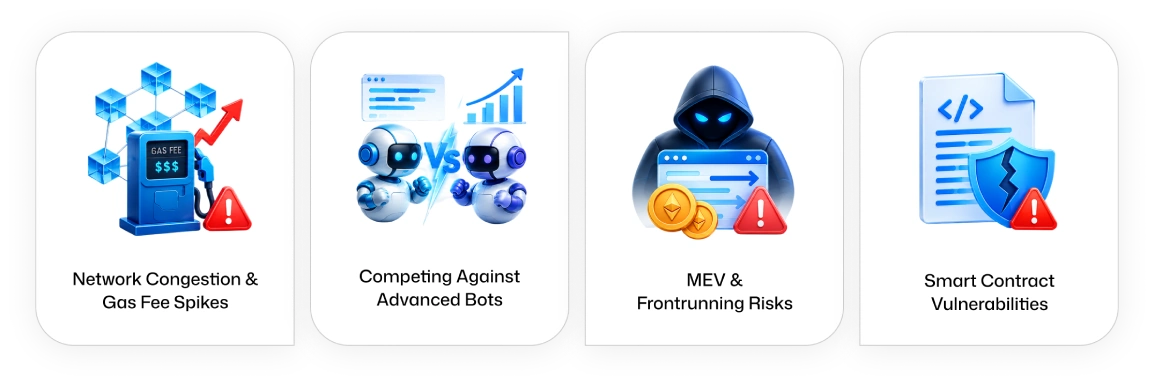
Network Congestion & Gas Fee Spikes
When a larger number of transactions and users come in, several blockchains like Ethereum and others would get clogged. And transactions may fail at times, or else it would demand higher gas fees to execute trades. A bot must adapt well to these changing conditions!
Competing Against Advanced Bots
You have to remember that you are not the only one to deploy bots, as several traders like you use bots to make profits. So, bots must be developed with strong and faster infrastructure and well-optimized code to stay in competition.
MEV & Frontrunning Risks
Bots can, at times, become victims of MEV strategies. Say, for example, a frontrunning bot could reorder, cancel, or even skip your trade in the block, thus making your transaction non-profitable.
Smart Contract Vulnerabilities
Integrating with poorly audited DEX contracts can lead to hacks and threats. Even a small vulnerability can drain funds instantly. Security audits are a must to ensure transactions are secured.
End Note
DEX trading bots have evolved more than just being experimental! They are becoming a survival kit for traders in an area where precision and speed matter the most.
For traders, running a DEX trading bot is more like unlocking opportunities that would help them catch possibilities that cannot be achieved manually.
If you are interested in developing a DEX trading bot, then partnering with an experienced cryptocurrency trading bot development company is the right move.
At fourchain we have experience in helping businesses to launch a cryptocurrency trading bot that reaps you unimaginable profits.

